You’ve been hiring for the same role for months.
There have been strong resumes. Good first interviews. A few candidates who looked promising enough to make it deep into the process.
But the seat is still empty.
Eventually, the question has to change.
Instead of asking “Where are all the good candidates?”, it may be time to ask:
“Is something wrong with our search?”
Because when a critical go-to-market role stays open, the problem isn't always a lack of talent.
Sometimes the role isn't clearly defined. Sometimes the compensation doesn't match the candidate profile. Sometimes the interview process is too slow. Sometimes the company is evaluating candidates without giving those candidates much reason to want the job.
And sometimes the search is simply looking for the right person in the wrong places.
If you've been trying to make the same GTM hire for 60, 90 or even 120 days, interviewing another group of candidates may not fix the problem.
Before you add more people to the pipeline, take a closer look at the search itself.
A search can start with a straightforward request:
We need an Account Executive.
Then the requirements begin to grow.
They should generate some of their own pipeline. They should probably have enterprise experience. Industry relationships would be helpful. Maybe they could own a few strategic partnerships. And ideally, they could grow into managing a team.
None of those requests sound unreasonable on their own.
Put them together, though, and you're no longer hiring an Account Executive.
You're looking for an AE, SDR, partnerships lead and future sales manager in one person.
We see versions of this all the time in GTM hiring. The title may be clear, but the actual job isn't.
That creates problems throughout the search.
The recruiter sources against one profile. The hiring manager evaluates another. An executive joins later and introduces a new requirement. Strong candidates get rejected, but nobody can quite explain what was missing.
Before searching for candidates, the hiring team should be able to answer four things clearly:
What will this person own?
What should be different 6–12 months after they join?
What experience do they truly need to make that happen?
What would be helpful, but isn't essential?
If the people interviewing candidates don't agree on those answers, the problem isn't your candidate pipeline yet.
The search needs more clarity.
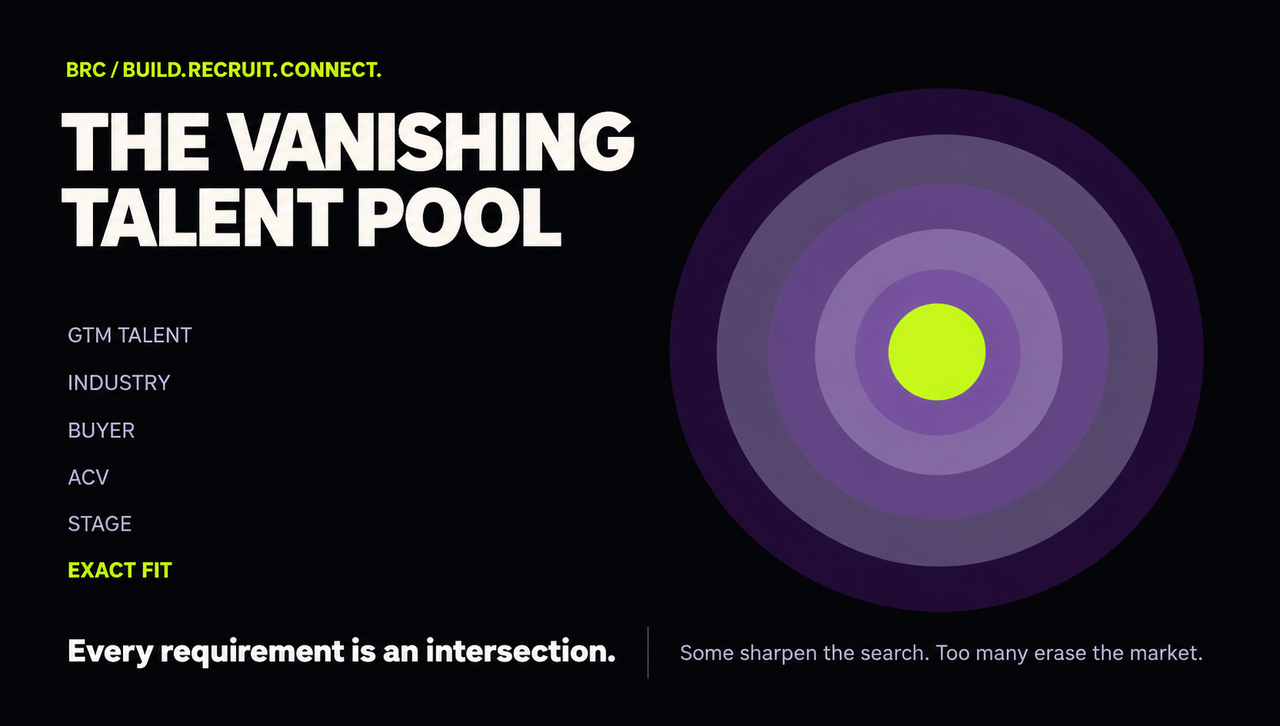
Once the role is defined, another problem can appear: the requirements are individually reasonable but collectively unrealistic.
You want someone who has sold your exact type of product to your exact customer.
They should have worked at a company around your size, carried a similar quota, sold at a similar ACV and navigated a similar sales cycle.
They need several years of experience, consistent quota attainment, a strong network and experience in a high-growth environment.
Ideally, they live in your market.
And your compensation range needs to work for them.
There may absolutely be people who meet every requirement.
There just may not be very many.
One of the most important distinctions we make when building a search is the difference between evidence of ability and evidence of sameness.
Those aren't the same thing.
A candidate doesn't necessarily need to have sold the exact same product to understand your buyer.
Someone from an adjacent industry may have navigated an almost identical sales motion. Someone with a different title may already own the responsibilities you're hiring for. A candidate from a larger company may have the right experience if you can establish that they know how to operate without all of the infrastructure around them.
The question shouldn't only be:
“Who has already done this exact job?”
A better question is:
“What evidence would make us confident this person can succeed here?”
That shift can open a search considerably without lowering the bar.
Compensation is one of the clearest forms of feedback a search can produce.
Imagine you're hiring for a senior sales role.
You want someone with enterprise experience, consistent quota attainment, executive relationships, a strong network, experience building a territory and a track record inside high-growth companies.
Then you start talking to candidates who fit the profile.
They're interested. The conversations go well.
And nearly all of them are already earning more than your range.
At that point, the recruiting process has uncovered something important.
The market and the candidate profile aren't aligned.
That doesn't automatically mean you should increase compensation.
Maybe the role should be leveled differently. Maybe the scope needs to change. Maybe some requirements aren't as essential as they originally seemed. Or maybe the business case supports paying more for the caliber of person you're trying to hire.
There are several ways to solve the problem.
Ignoring the signal isn't one of them.
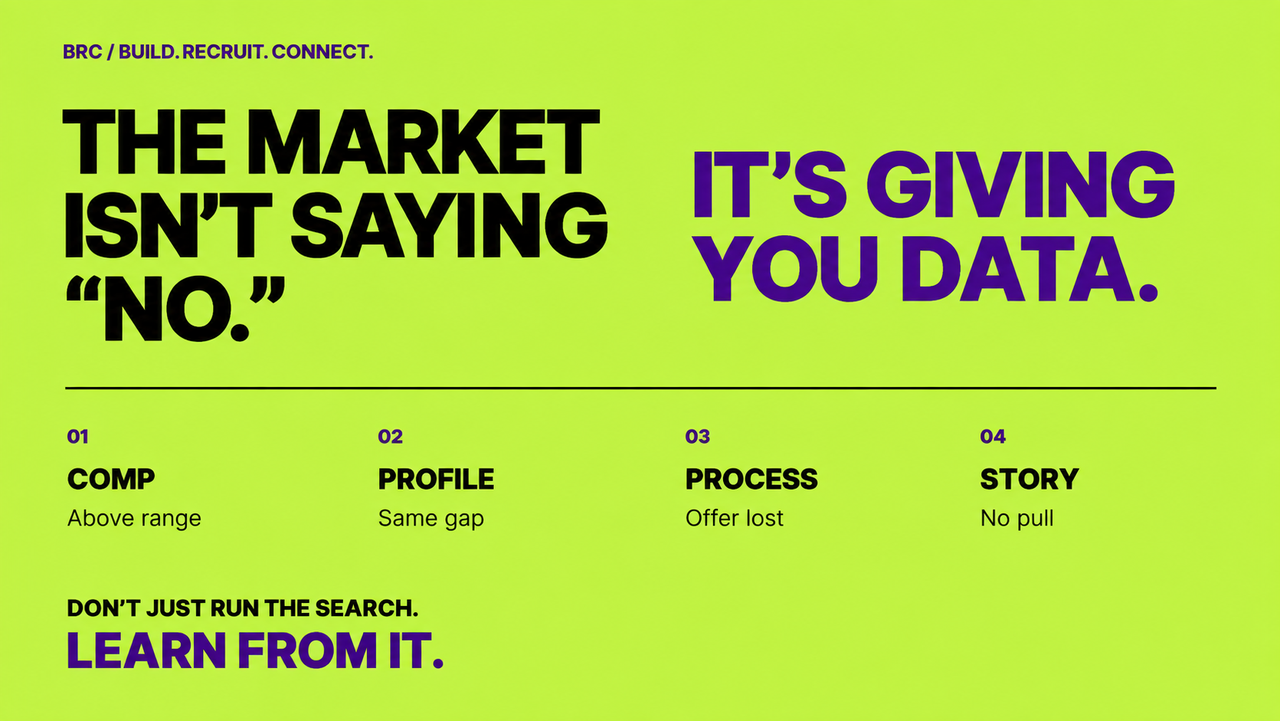
If strong candidates keep giving you the same feedback, don't treat every conversation like an isolated data point.
The market is giving you feedback. Listen to it.
You finally find someone great.
The recruiter speaks with them this week. The hiring manager gets on the calendar next week. Another leader wants to meet them after that.
Then there's a panel.
Then a case study.
Then someone decides one more executive should meet the candidate before an offer.
That executive is traveling.
The team needs a few days to debrief.
By the time everyone agrees that this is the person they want, the candidate is gone.
Strong candidates don't experience your hiring process in isolation.
They're often talking to several companies at once, and they're evaluating you just as closely as you're evaluating them.
They're noticing whether interviews start on time. Whether the people interviewing them seem prepared. Whether everyone tells the same story about the role. Whether promised feedback actually arrives. Whether there's momentum or whether every next step requires another week of waiting.
Those things communicate something about the company.
The interview process is often a candidate's first real experience working with your team.
That doesn't mean an important hire should be rushed. It means the process should be intentional.
Every interview should answer something the team actually needs to know. Every interviewer should understand what they're responsible for evaluating. And once the team has enough information to make a decision, there shouldn't be another round simply because nobody wants to make the call.
Ask your hiring team one question:
If the right candidate entered our process today, how quickly could we confidently hire them?
You should know the answer before that candidate arrives.
Most interviews spend a lot of time answering:
Why should we hire this person?
Not enough time is spent answering the question on the other side of the table:
Why should this person join us?
That matters most when you're recruiting high performers.
The strongest candidate for your role may already have a job they like. They may have a good manager. They may be earning well, hitting their goals and building a strong reputation internally.
They weren't searching for your company.
You found them.
So what makes leaving worth it?
Candidates need to understand why the company is interesting now, why the role matters, what they'll own, what they can build, who they'll work with and what this opportunity could mean for their career.
For an early or growth-stage company, this becomes even more important.
You may not be able to compete with a larger company on brand recognition or infrastructure.
But you may be able to offer ownership, access to leadership, the ability to build something from the ground up, faster career growth or meaningful upside if the company succeeds.
Those things have value.
But only if somebody tells the story.
We've seen companies have genuinely compelling opportunities and struggle to close candidates because the interview process was designed entirely around assessment.
Recruiting isn't only about deciding whether you want the candidate.
You also have to give the right candidate a reason to want you.
Post the role.
Wait for applications.
Review resumes.
Interview the strongest applicants.
For some searches, that's enough.
For difficult GTM hiring, it often isn't.
Because some of the strongest candidates aren't looking for another job.
They're busy doing the job you want them to do for you.
They're carrying a quota. Growing accounts. Building partnerships. Leading a team. Launching campaigns. Getting promoted.
They may not have updated their LinkedIn profile in two years.
Their current title might not match the title you're searching.
And until somebody reaches out with the right opportunity, changing jobs may not even be on their mind.
That's why proactive recruiting changes the size and quality of the market available to you.
Instead of asking:
“Who applied?”
You start asking:
“Who should know this opportunity exists?”
Those are fundamentally different talent pools.
The goal isn't to generate the biggest stack of resumes.
It's to create conversations with the people who have the strongest chance of solving the business problem behind the hire.
Sometimes those people apply.
Sometimes you have to go find them.
A recruiter is sourcing candidates.
The hiring manager is interviewing them.
An executive makes the final decision.
Everyone is involved.
But who owns the search?
That's a different question.
Someone should know exactly where every candidate stands, why people are being rejected, where the process is slowing down, what candidates are saying about compensation and whether the original profile is actually producing the talent the company expected.
That person should also be able to spot patterns.
If every candidate is missing the same requirement, perhaps the sourcing strategy needs to change.
If nearly every qualified candidate is above budget, perhaps compensation needs another look.
If great candidates keep withdrawing after the same stage, perhaps there's a problem with the process.
If the hiring team keeps changing its mind about what it wants, sourcing more people isn't going to fix that.
A good search shouldn't simply produce candidates.
It should produce information.
Someone needs to own turning that information into decisions.
Otherwise, a search can remain active for months without actually getting closer to the hire.
After enough time passes, companies can start thinking about an open role as a recruiting problem.
How many candidates are in the pipeline?
How many interviews have we completed?
How many resumes do we need next week?
Those metrics matter.
But they're not the reason the company started hiring.
There's a business need behind the role.
An Account Executive was supposed to cover a territory and generate revenue.
A sales leader was supposed to coach the team, establish process and improve performance.
A demand generation leader was supposed to create pipeline.
A customer success hire was supposed to protect and grow customer relationships.
A partnerships leader was supposed to build a channel that doesn't exist yet.
And while the seat stays empty, that work doesn't disappear.
Someone else absorbs it.
The founder keeps doing it. Another executive stretches further. The team operates without the leadership it needs. Opportunities get delayed. Revenue that could have been generated isn't.
That's when a recruiting problem becomes something larger.
An empty seat can become a growth problem.
And once that happens, the goal shouldn't be to keep the recruiting process busy.
The goal should be to figure out why the hire hasn't happened.
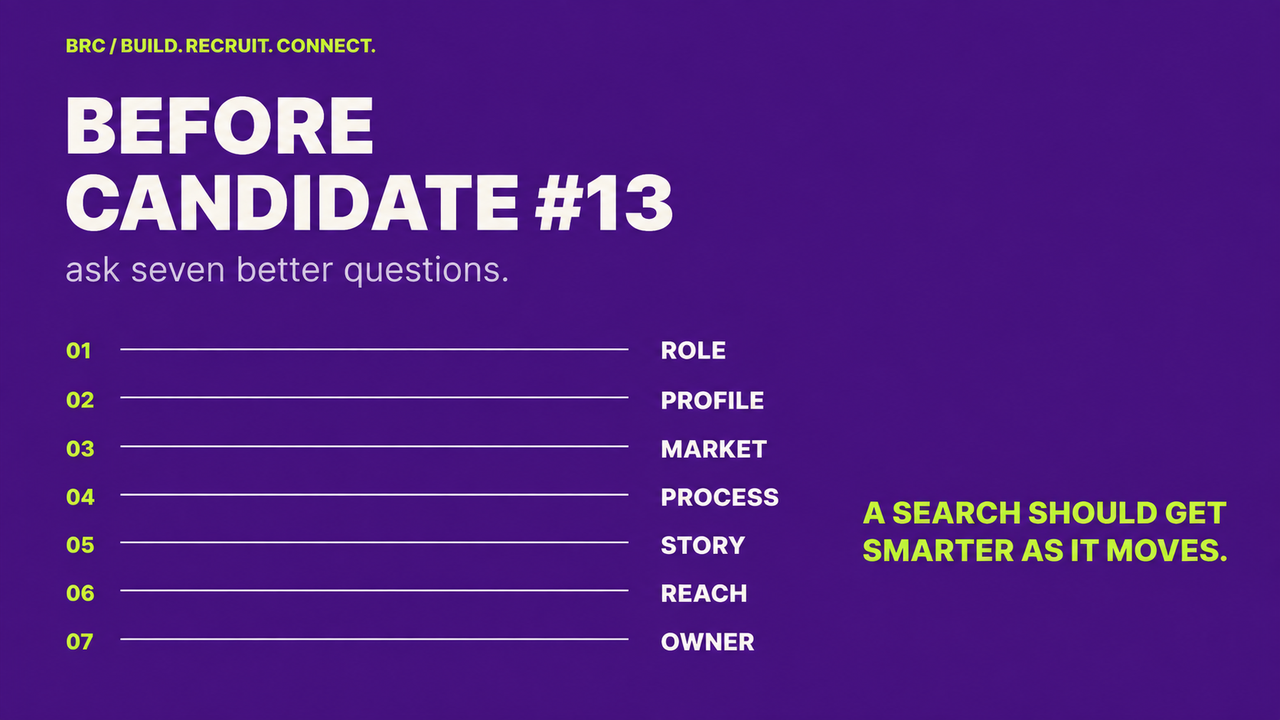
If an important GTM role has been open for 60 days or longer, pause before automatically adding more candidates to the pipeline.
Ask:
If the answer to several of those questions is no, another batch of resumes probably isn't the solution.
You may not have a candidate problem.
You may have a search problem.
At BRC, we believe recruiting starts before the first candidate conversation.
It starts by understanding why the company is hiring in the first place.
What needs to change when this person joins? What does success look like? Which experiences actually matter? What kind of candidate market exists for that profile? And what will make the right person want to have the conversation?
Get those things right and recruiting becomes much more focused.
You know who you're looking for.
You know where to find them.
You know what you're evaluating.
And when the market gives you new information, you know how to adjust.
Because the goal isn't to send more resumes.
It isn't to schedule more interviews.
It's to make the right hire and get the business what it needed when it opened the role in the first place.
If your GTM role has been open for months, don't automatically restart the same search with another group of candidates.
Take what the search has already taught you.
Then build a better one.
Build. Recruit. Connect.