Most startup hiring conversations begin with the same question: Who do we need next?
The first salesperson. A Head of Sales. Someone to finally own marketing. Another Customer Success hire as the customer base grows.
But there's another question that can have just as much impact on the business: When should a startup actually make the hire?
Hire too early, and you add payroll before the business is ready. Wait too long, and the cost doesn't disappear. It shows up somewhere else in missed revenue, founder time, overloaded teams, slower execution, or customers who aren't getting the attention they need.
We've seen this with growing startups again and again. Leadership often knows which role the company will eventually need. The harder part is recognizing when "eventually" should become "now."
And by the time the need feels obvious, the company may already be hiring from behind.
At BRC, we look at five signals that can help founders and leaders recognize that moment earlier: Revenue, Founder Time, Team Capacity, Growth Stage, and Cost of Waiting.
Together, they make up the BRC Hiring Trigger Framework.
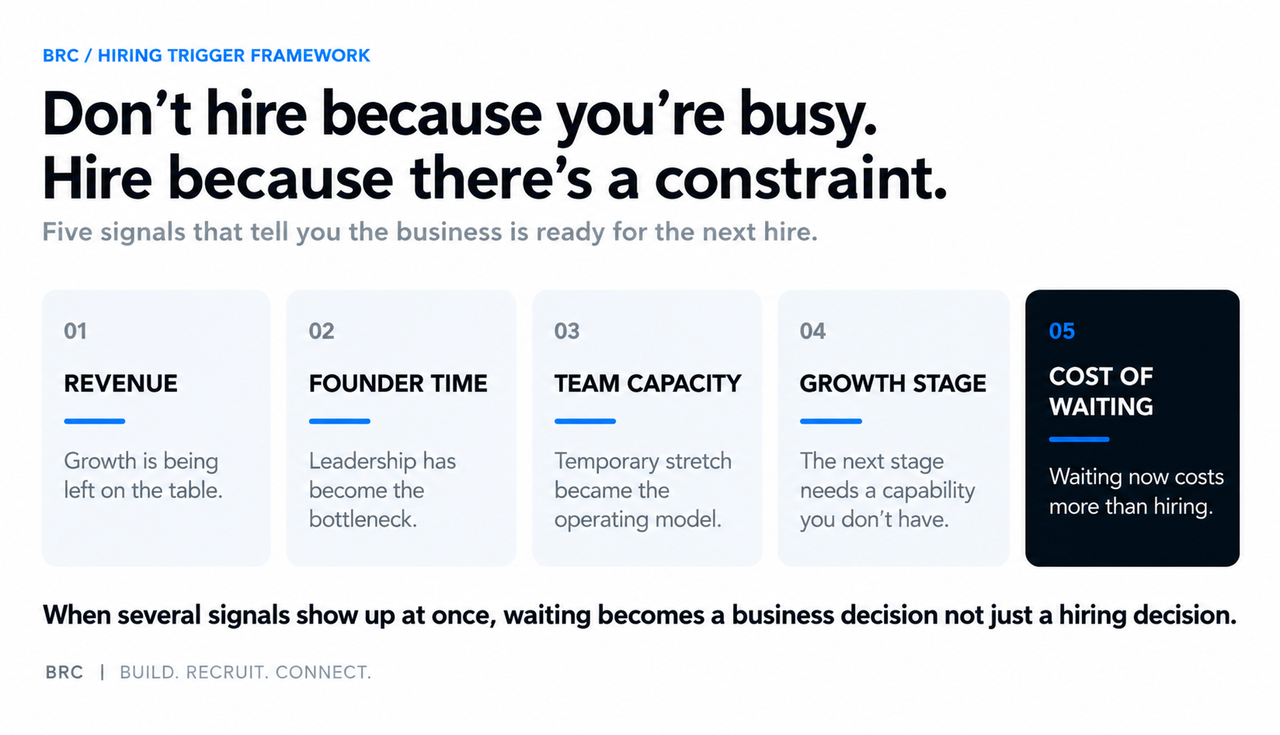
1. Revenue Is Being Left on the Table
One of the clearest signs it's time to hire is when a missing capability starts limiting your ability to capture, grow, or protect revenue.
That doesn't always mean hiring another salesperson.
Maybe there are more qualified opportunities than your existing team can properly work. Customers are signing, but nobody owns expansion. Your sales team can close more business but doesn't have enough pipeline. Partnerships could become a meaningful growth channel, but no one owns building them.
In each case, the business has an opportunity it can't consistently capture with the team it has today.
That's why "Are we busy enough to hire?" isn't the most useful question.
A better one is: What could this person unlock that we can't consistently execute today?
If the answer connects directly to generating, expanding, or protecting revenue, you may have a real hiring trigger.
A great hire doesn't just add capacity. They remove a constraint.
2. Founder Time Has Become the Bottleneck
In the earliest stages of a startup, founders do almost everything. They sell, recruit, talk to customers, help with marketing, build partnerships, and step into whatever needs attention.
That's often exactly what the company needs.
But as the business grows, there comes a point when founder involvement in everything starts working against growth.
If the CEO is still personally managing nearly every sales opportunity, there may be a sales hiring trigger. If the founder is spending hours every week coordinating marketing campaigns, there may be a marketing trigger. If every major customer relationship requires executive involvement, the business may have outgrown its current Customer Success structure.
The goal isn't to remove founders from areas where they're uniquely valuable. It's to recognize when their involvement has shifted from an advantage to a bottleneck.
One way to see that more clearly is to ask: If we gave the founder 10 hours back every week, where would those hours create more value?
Product? Fundraising? Strategy? Executive hiring? Key customers? Partnerships?
Sometimes the ROI of a hire isn't just what the new person can do. It's what they allow your highest-value people to stop doing.
3. Your Team Has Been Stretching for Too Long
Strong teams can hide hiring problems.
An AE covers another territory. A Customer Success Manager takes a few more accounts. A manager jumps back into individual contributor work. Someone in sales owns the reporting because there isn't a RevOps person yet.
For a while, that's resourcefulness.
The problem is when temporary solutions quietly become the way the company operates.
Important projects keep getting pushed back. High performers spend more time outside their core responsibilities. Managers are covering so much execution that they have less time to manage. Customer response times slow down. Critical work becomes dependent on one or two people who are already at capacity.
That doesn't automatically mean you should hire. Sometimes the answer is better process, clearer priorities, automation, or simply stopping work that no longer matters.
But when the work is important, sustained, and necessary for growth, capacity becomes a hiring signal.
The question isn't whether your team can keep stretching.
It's how long you want growth to depend on them doing it.
4. You're Hiring for the Company You're Becoming
Some hires solve today's problems. Others prepare the business for what's coming next.
A startup moving from founder-led sales to a repeatable sales motion needs different capabilities. A company moving upmarket may need sellers who understand larger contracts, longer sales cycles, and complex buying committees. A growing customer base may require Customer Success to evolve from reactive support into a function focused on retention and expansion.
This is why a startup hiring strategy can't be built entirely around what the business looks like today.
Founders and leaders should be asking: What capabilities will we need for the company we're becoming?
Then work backward.
Finding the right candidate takes time. So does interviewing and closing them. Once they join, they still need time to learn the product, customers, team, and go-to-market motion.
If you wait until you need someone operating at full speed to begin the search, you're already late.
Your hiring timeline should start with when you need impact not when you want someone to start.
5. The Cost of Waiting Is Becoming Greater Than the Cost of Hiring
The cost of making a hire is easy to see.
Salary. Benefits. Equity. Recruiting. Onboarding. Management time.
The cost of waiting is harder to see.
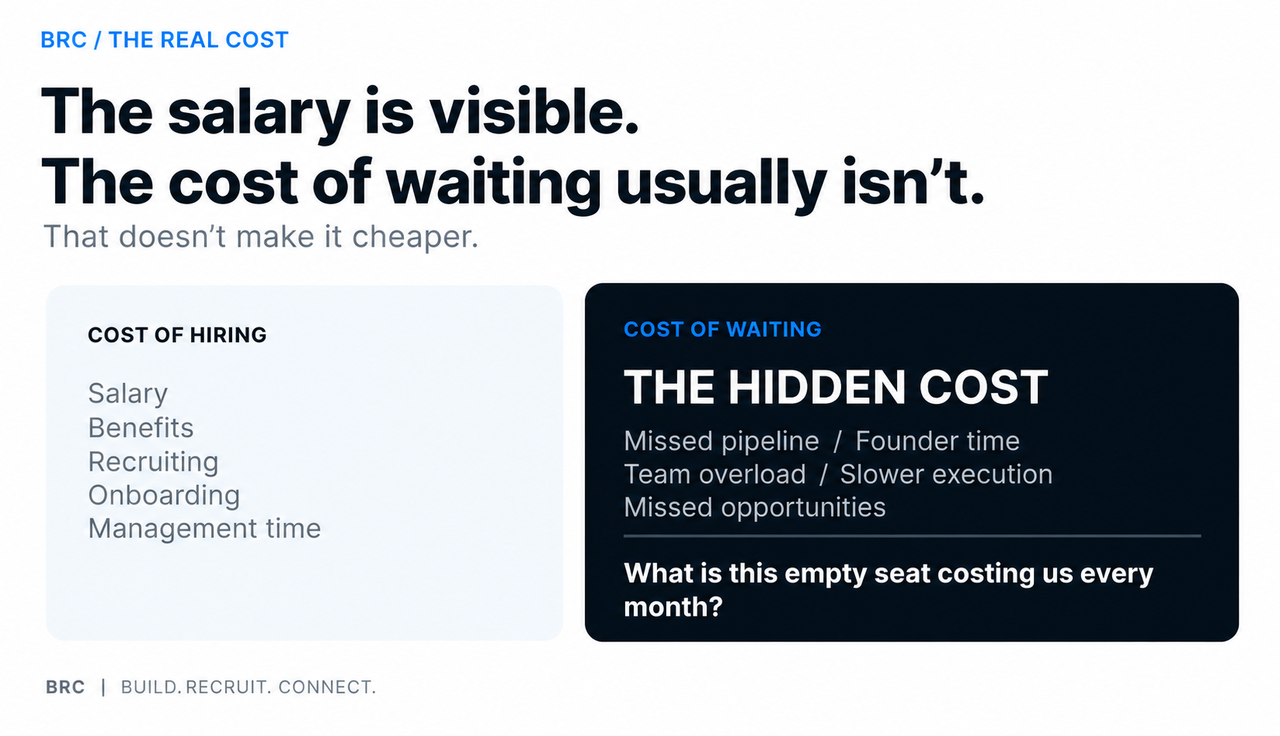
Imagine you're considering a $120,000 hire. The expense is immediately visible. What's less obvious is what another 90 days without that person could cost the business.
How much pipeline isn't being generated? How many opportunities aren't getting enough attention? How much founder or executive time is still being consumed? Are customers receiving less attention? Is the team moving more slowly?
You won't always be able to put a perfect dollar amount against those questions. You don't need to.
The point is to evaluate both sides of the decision.
Instead of asking only, "Can we afford to hire this person?", ask:
"What is it costing us every month that this seat stays empty?"
Sometimes the right decision will still be to wait. But now you're evaluating the cost of hiring against the cost of doing nothing.
Don't Start With the Title. Start With the Constraint.
Being busy isn't enough reason to hire, and adding headcount won't fix a broken process.
Before opening a role, get clear on the problem.
What isn't happening today? Why isn't it happening? What's the impact on the business? Can it be solved without adding headcount? If not, what capability is actually missing?
This matters because the role you think you need isn't always the role you actually need.
You may think you need another AE when the real constraint is pipeline generation. You may think you need another Customer Success hire when the underlying problem is process. You may think you need a VP when what the business really needs is a strong individual contributor.
Don't start with the title. Start with the constraint.
Being busy isn't enough reason to hire, and adding headcount won't fix a broken process.
Before opening a role, get clear on the problem.
What isn't happening today? Why isn't it happening? What's the impact on the business? Can it be solved without adding headcount? If not, what capability is actually missing?
This matters because the role you think you need isn't always the role you actually need.
You may think you need another AE when the real constraint is pipeline generation. You may think you need another Customer Success hire when the underlying problem is process. You may think you need a VP when what the business really needs is a strong individual contributor.
Once the constraint is clear, the hire usually becomes clearer too.
So, When Should a Startup Hire?
There isn't one revenue number, employee count, or funding round that tells every startup when to hire.
Instead, look for the signals.
Is a missing capability holding back revenue? Is leadership spending too much time on work someone else should own? Has temporary team stretch become permanent? Will the next stage of growth require capabilities you don't have today? What happens if the seat stays empty for another 90 days?
You don't need all five signals.
But when several begin appearing at the same time, the question may no longer be whether you'll eventually need the role.
It may be how much waiting is already costing you.
Build Before the Bottleneck
Startup hiring will never be perfectly timed. The goal isn't to predict every role you'll need over the next two years.
It's to recognize the signals early enough to make an intentional decision before the missing hire becomes an urgent problem.
Because urgency doesn't make hiring faster. You still have to define the role, find the right candidates, interview them, make a decision, close the person, and give them time to ramp.
The difference is that when you wait too long, you're doing all of that while the business is already feeling the impact of the missing seat.
So the next time your leadership team starts discussing headcount, don't ask only:
Who do we need next?
Ask:
What does the business need next, and when do we need that person making an impact?
That's the shift from reacting to growth to building for it.
At BRC, that's how we think about hiring: build before the bottleneck.
Build. Recruit. Connect.