For founders, every early hire has always mattered. But in 2026, the expectations attached to those hires are getting higher.
Leaner teams, AI-enabled workflows, and tighter operating environments are changing what companies need from the people they bring in. The question is no longer simply whether someone has the experience to do the job.
Increasingly, it's whether that person can expand what the company is capable of doing.
That may be one of the most important startup hiring trends in 2026.
For the last two years, much of the conversation around AI and hiring has focused on one question:
Which jobs are going away?
But that may not be the most interesting hiring question anymore.
Earlier in the AI cycle, Artisan attracted plenty of attention with its “Stop Hiring Humans” campaign. In 2026, the conversation looks different. Its messaging has shifted toward “BE MORE HUMAN,” even as the company continues building around AI.
The takeaway isn't that AI failed.
It's that companies are getting more specific about the work technology can absorb and the people who become even more valuable because they know how to work alongside it.
We're seeing a version of that shift across startup and GTM hiring.
The conversations BRC is having with founders and hiring leaders feel different than they did even a few years ago. A recognizable company on a resume still matters. Experience still matters. Domain knowledge still matters.
But increasingly, none of those things are enough on their own.
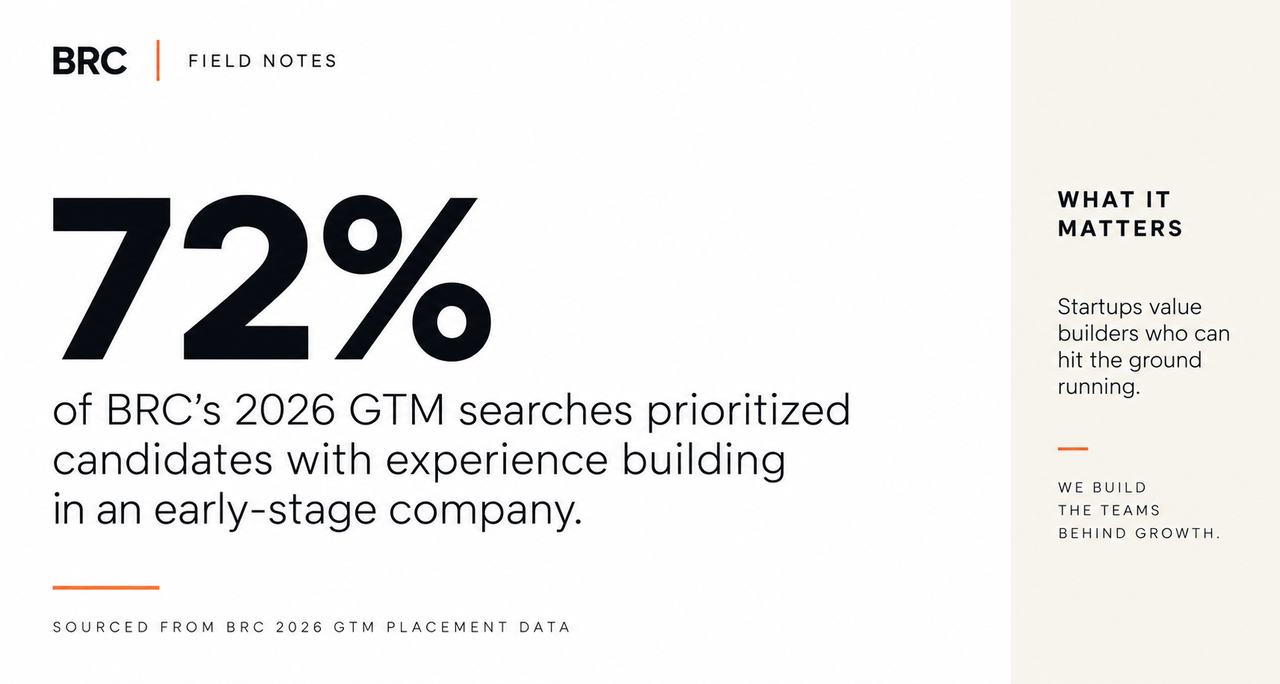
In BRC's 2026 startup hiring data, 72% of GTM searches emphasized prior experience building in an early-stage environment.
That distinction matters.
Companies aren't simply looking for candidates who have worked at impressive organizations. They're increasingly looking for evidence that someone has operated in an environment where the playbook was still being written.
Founders want to know what someone actually built. What changed because they were there? Can they operate before every process exists? Can they use AI to become more effective? Can they create impact beyond the boundaries of their job description?
The definition of a great startup hire is changing.
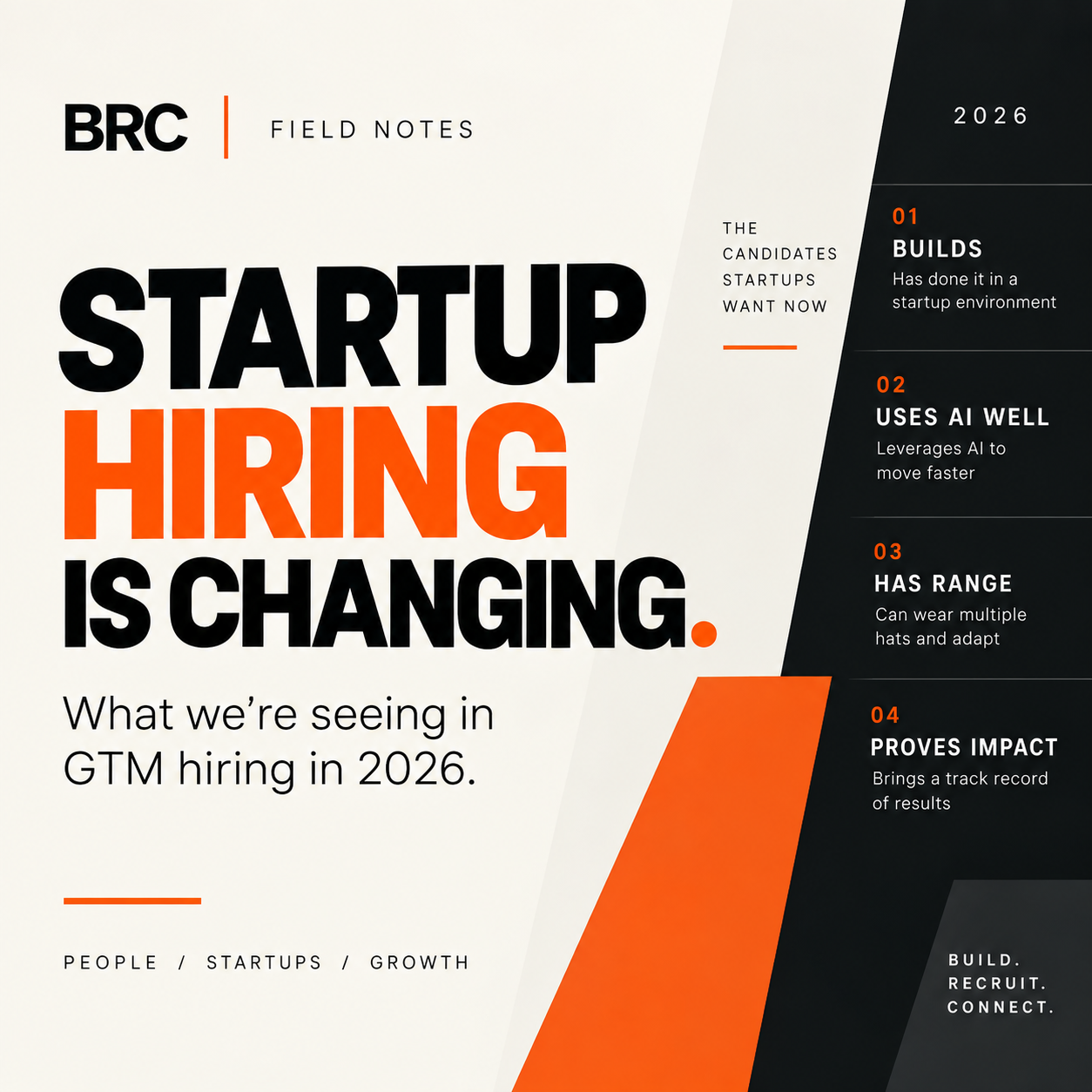
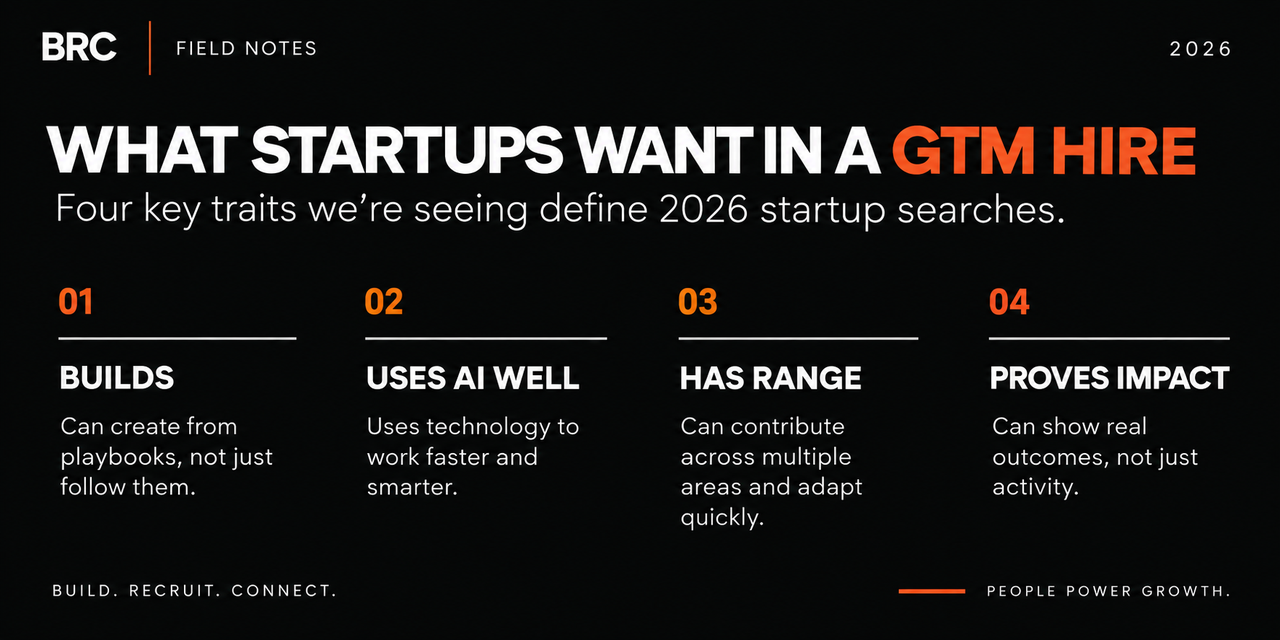
Here are four startup hiring trends we're seeing across GTM teams in 2026.
1. Startups Are Prioritizing Builders Over Pedigree
There was a time when a recognizable logo on a résumé could carry significant weight in a hiring process.
It still opens doors.
But for many early-stage companies, another question is becoming much more important:
What did you actually build there?
Working at a great company and helping build a great company aren't necessarily the same thing.
That distinction matters in startup hiring, particularly at the Seed and Series A stages.
Someone joining an early-stage company may walk into an incomplete sales process, evolving messaging, limited brand awareness, a small team, and a job description that looks different six months after they start.
There may not be a playbook to follow.
They may be expected to help write it.
That's why some of the strongest candidates we see aren't simply good at describing their responsibilities. They can describe the before and after.
They can tell you what the situation looked like when they arrived, what wasn't working, what they changed, what they built, what worked, what didn't, and what was different because of their contribution.
For founders, this changes what pedigree should mean in a hiring process.
A recognizable company can tell you where someone has been.
Evidence of building tells you what they may be capable of creating next.
For an early-stage company, that difference can be significant. You're not only hiring someone to execute a playbook. In many cases, you're hiring someone to help create one.
2. AI Fluency Is Becoming a Baseline Skill in GTM Hiring
One of the clearest GTM hiring trends in 2026 is that AI fluency is moving beyond technical roles.
We're seeing the expectation show up across sales, marketing, recruiting, customer success, operations, and other GTM functions.
But there's an important distinction between knowing the names of AI tools and actually knowing how to use them well.
The stronger signal is whether someone understands where technology can make them faster or better—and where human judgment still needs to lead.
A salesperson might use AI to accelerate account research while recognizing that a high-stakes executive conversation still requires context, judgment, and trust.
A marketer might use AI to analyze information or accelerate a first draft while still owning the positioning, customer insight, and final point of view.
A recruiter might use AI to improve research while understanding that evaluating motivation, career decisions, and fit still requires a real conversation.
The hiring question is becoming less: “Do you use AI?” And more: “Has AI changed the way you work?”
That's a much higher bar.
For founders operating with leaner teams, this has a direct business implication.
The right person using technology effectively may be able to research faster, analyze more information, automate repetitive work, and spend more time on the decisions and relationships where human judgment matters most.
That doesn't necessarily mean replacing people with AI.
It means the output expected from an individual role is changing.
The candidates who stand out won't necessarily be the people using the most AI. They'll be the people who understand where it creates leverage and where it doesn't.
3. Startups Are Hiring for Range, Not Just Specialization
Early-stage companies have always asked employees to wear multiple hats.
But we're seeing something slightly different in startup GTM hiring now.
Companies aren't necessarily looking for generalists who can do a little bit of everything. They're looking for people who can own a core function and stretch beyond it when the business needs them to.
Take an early sales hire.
The job may technically be closing revenue. In reality, that person may also influence messaging, give product feedback, identify patterns in the market, help refine the ICP, and eventually contribute to how the next group of sellers is onboarded.
The same dynamic exists across marketing, customer success, partnerships, and other GTM roles.
At a larger organization, many of those responsibilities might sit across several teams.
At a startup, the lines are rarely that clean.
That changes what companies should screen for when hiring.
It's no longer enough to determine whether someone has performed every responsibility listed in a job description. Hiring teams also need to understand how that person operates when the job becomes bigger than the job description.
For founders, that's especially important because the company itself is changing quickly.
The person you hire today may be solving a different set of problems 12 months from now.
Specialization can get someone into the seat. Range helps them grow with it.
The best early hires don't just fit the company you have today. They have the capacity to evolve with the company you're trying to build.
4. Evidence of Impact Is Becoming More Important Than Years of Experience
Years of experience still matter.
But they're an imperfect shortcut for capability.
Two candidates can each have eight years of experience and have operated at completely different levels of ownership.
One may have spent those years inside established systems with significant resources, brand recognition, and clearly defined responsibilities.
Another may have helped create the systems themselves.
That difference matters when you're hiring for a startup where much of the infrastructure still needs to be built.
Instead of only asking: “How many years have you done this?” hiring teams should spend more time asking: “What changed because you were there?”
Maybe someone opened a new market. Built the company's first outbound sales motion. Turned an early customer success function into an expansion engine. Created a demand generation program from scratch. Built a partnerships motion from zero. Helped a founder turn founder-led sales into something the company could begin to repeat.
Those stories reveal something years of experience alone can't. They reveal ownership.
And ownership matters disproportionately in startups, where there are often fewer people, fewer resources, and more problems still waiting to be solved.
For a founder, the objective isn't simply to find someone who has held the right title for the right number of years. It's to understand what that person can change inside the business.
What Do the Startup Hiring Trends of 2026 Mean for Founders?
Taken together, these shifts point toward a different way of evaluating startup talent.
Experience still matters. Recognizable companies still matter. Specialization still matters.
But founders and hiring leaders increasingly need to look beyond those traditional signals.
Can this person build without a complete playbook? Can they show measurable impact rather than simply describe responsibilities? Can they use AI and technology to increase their effectiveness? Can they stretch beyond their core function when the company needs them to? Can they operate with ownership in an environment that is still being built?
The strongest startup candidates we're seeing in 2026 tend to combine expertise with range. They use technology without outsourcing their judgment to it. They know how to execute, but they can also build. They understand their role while thinking about the business around it.
And most importantly, they can explain what changed because they were there.
That may lead to a better hiring question than simply: “Can this person do the job?”
What becomes possible if we hire this person?
Because the biggest shift in startup hiring in 2026 may not be about hiring fewer people or more people.
It's about expecting more leverage from every person you hire.
For founders building the next stage of their company, that changes the hiring conversation.
You're not simply filling a seat.
You're deciding who gets to help build what comes next.
BRC Field Notes is our ongoing look at what we're seeing inside startup hiring from the roles companies are building to the skills, profiles, and signals changing along with them.
About the Data
BRC's 2026 startup hiring data is based on GTM searches conducted by BRC for startup and growth-stage companies during 2026. The 72% figure represents the share of analyzed GTM searches in which prior experience building or operating in an early-stage environment was emphasized as part of the candidate profile.
Building your GTM team? BRC partners with startups and growth-stage companies to identify and recruit the people behind their next stage of growth.