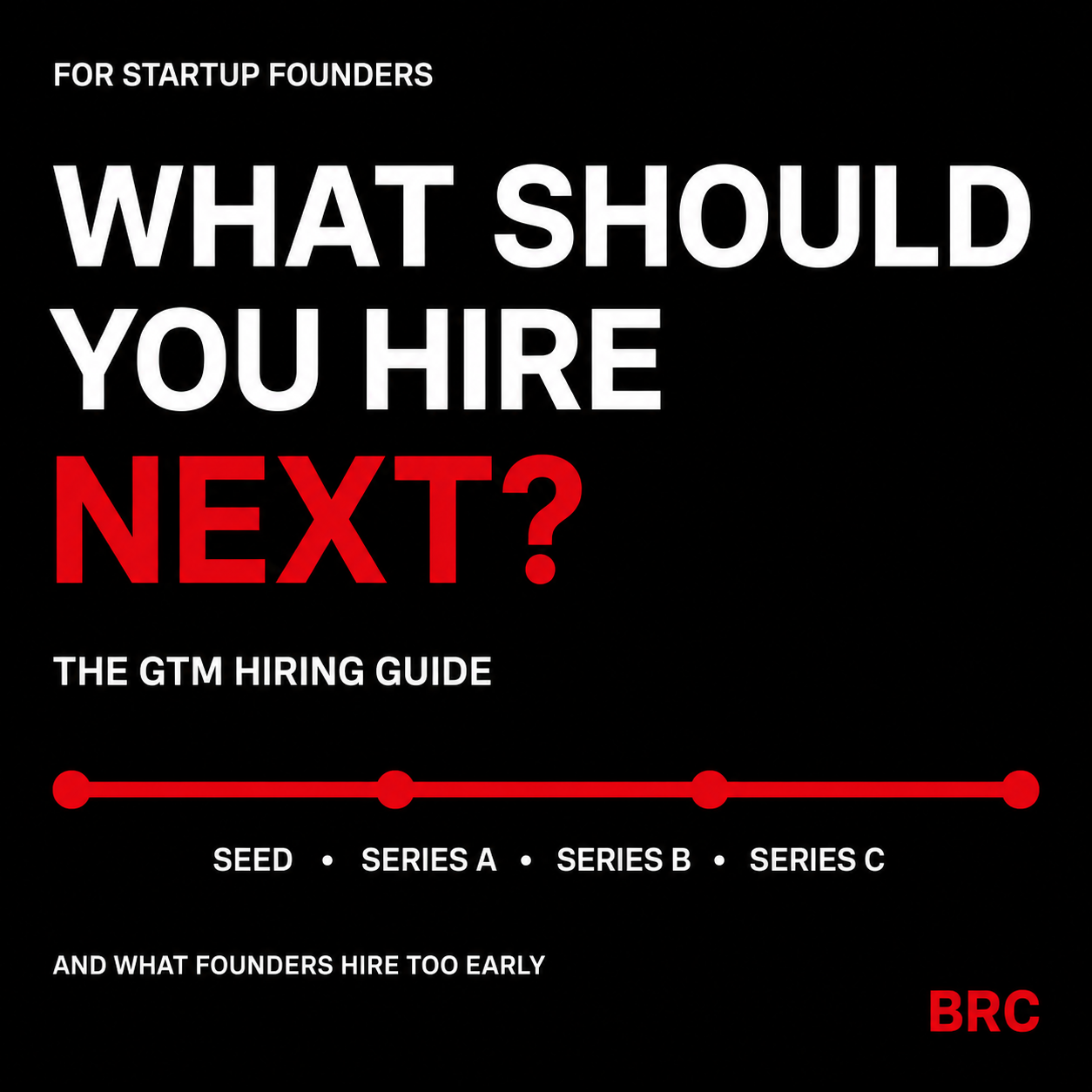
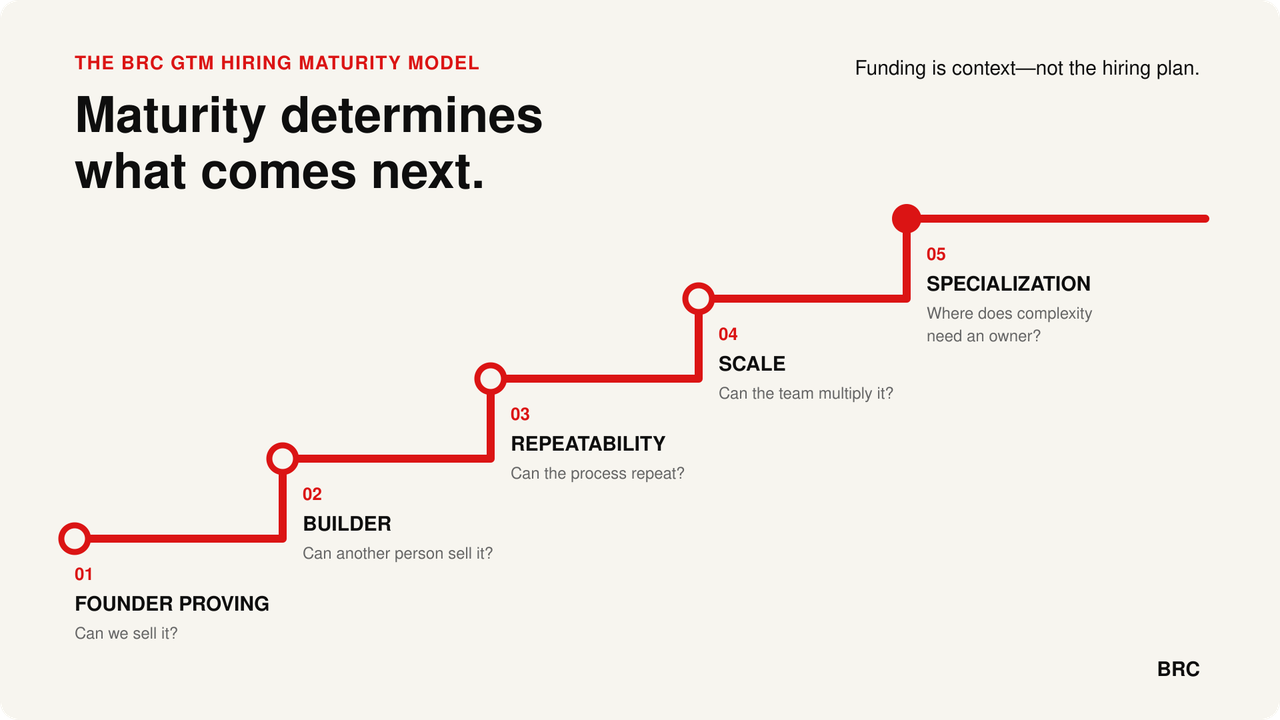
Funding can make hiring feel straightforward. Raise a Seed round, build the team. Reach Series A, add more salespeople. Raise Series B, bring in leadership. In practice, it rarely works that neatly. Two companies at the same funding stage can have very different sales cycles, contract sizes, customer needs, and levels of founder involvement. One may be ready for a sales leader while another still needs a hands-on builder. At BRC, we look at GTM (Go-To-Market) hiring through a maturity lens: Founder Proving, Builder, Repeatability, Scale, and Specialization. That distinction matters even more as startups build leaner teams. Carta reports that the median Seed-stage team now consists of just four employees, while average Series B headcount fell from 53 employees in 2023 to 45 in 2025. Funding may provide more resources, but it no longer automatically produces a larger organization. The funding stage can provide context, but the maturity of the GTM motion is what should determine what comes next.
Seed: Prove and Build
At the Seed stage, the company is still figuring out what works. The founder is learning who buys, why they buy, and how to sell the product. The sales process is likely to change as the company learns more. The objective at this stage is to prove the sales motion while beginning to build something another person can eventually repeat.
This is where a Founding Account Executive (AE) or full-cycle GTM generalist can make sense. The person needs to sell while also helping build the earliest version of the sales process. Depending on the company's needs, a first marketer may also be appropriate. BRC typically sees the Founding AE conversation emerge when the founder understands who the company is selling to and why customers buy, but founder-led selling is beginning to constrain growth. With Carta reporting a median Seed-stage team size of just four employees, early GTM hires still need to operate as builders, not narrow specialists. At that point, the company needs someone who can sell,learn, and help build the process not someone whose primary job is managing a larger sales organization.
The company is ready to move forward when customers are consistently paying, an ideal customer profile (ICP) is emerging, and the founder can transfer an actual sales motion instead of just personal relationships and instinct. A common mistake at this stage is hiring a VP of Sales or Chief Revenue Officer (CRO) too early. If the job still consists mostly of prospecting, demoing, closing, testing messaging, and figuring out what works, the company may need a builder rather than a leader.
Series A: Build Repeatability
By Series A, the focus begins shifting from proving that sales can happen to making the process more repeatable. The objective is to take what the founder and early team have learned and turn it into a process that more people can follow. This can mean adding more full-cycle AEs, introducing Sales Development Representatives (SDRs), expanding Customer Success (CS), and putting basic Revenue Operations (RevOps) infrastructure in place. A player-coach sales lead may also make sense as the team grows.
The expectations placed on Series A companies have also increased. According to data highlighted by Carta from Silicon Valley Bank, median annual recurring revenue among U.S. B2B companies raising a Series A reached nearly $3 million in 2024, compared with $1.3 million in 2021. That does not mean every company follows the same revenue path, but it shows why investors increasingly expect stronger evidence of traction and repeatability before this stage. The operational question is whether someone other than the founder can follow the process and produce similar results. (Insert picture) That matters when deciding whether to build an SDR team. SDRs can create more pipeline, but they are not a substitute for a sales motion that has already been tested. Before adding several SDRs, founders should have a clear target customer, messaging that gets a response, reliable data, and a working handoff between SDRs and AEs. The same principle applies to management. If there are only a few people on the team and the motion is still changing quickly, adding another layer of management can create more overhead than leverage.
Series B: Scale the Engine
Series B is where the company can start adding structure around a GTM motion that has demonstrated it can work. The objective is to scale the existing engine without losing the consistency that made it work in the first place. This may be the point to bring in a VP of Sales, build defined SDR and AE teams, strengthen RevOps, add sales enablement, and expand Customer Success and marketing capabilities.
Even at Series B, companies are operating with leaner teams. Carta reports that average Series B headcount declined from 53 employees in 2023 to 45 in 2025. This makes the sequencing of GTM hires more important: companies have less room for roles that do not create clear leverage. The difference at this stage is that leadership and specialized roles should now have something proven to build upon. There should be enough team density to justify leadership, enough volume for specialization, and enough operating data to identify where the process is breaking down.
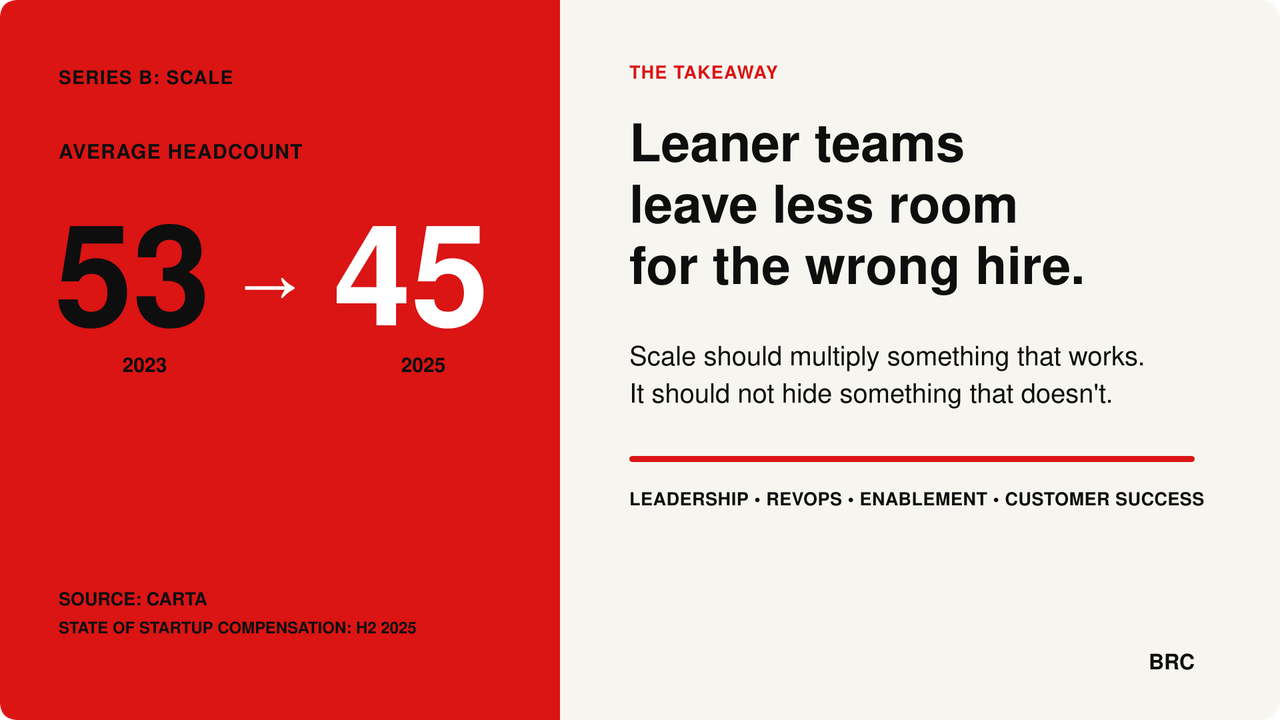
But adding people does not automatically solve GTM problems. If conversion is weak, positioning is unclear, or the process is inconsistent, a larger team can simply create more activity without improving the underlying results. Scale should multiply something that works not hide something that doesn't.
Series C: Specialize and Expand
By Series C, the GTM organization may be ready for more specialized roles. The objective is to improve efficiency, expand into new opportunities, and give established functions more focused ownership. That can include segment leaders, enterprise teams, partnerships or channel roles, and deeper enablement, RevOps, Customer Success, and marketing capabilities. The company should have enough operating data and a clearer understanding of its core segments to support that additional complexity. This is also where founders can start thinking about expansion: new markets, customer segments, products, or channels without losing sight of the engine that already works. But specialization should still solve a real business problem. A new title, function, or management layer should exist because the complexity of the business requires it, not simply because the company's org chart is beginning to resemble that of a larger organization.
How the GTM Roles Fit Together
As the company grows, these roles are not independent additions to an org chart. They are connected parts of the same GTM motion. Marketing helps create demand and shape the message. SDRs turn that demand into qualified opportunities, while AEs take those opportunities through the sales process and close the deal. Customer Success takes over after the sale to drive onboarding, retention, and expansion. RevOps connects these functions through systems, data, processes, forecasting, and reporting, while enablement helps teams execute consistently.
Leadership becomes more important as the team, functions, and decisions become more complex. That is also why sequencing matters. Adding SDRs before the company has a clear target and message can create more activity without a better pipeline. Adding RevOps too late can leave teams working from inconsistent data and processes. Hiring sales leadership before there is enough of a team or repeatable motion can create management overhead before there is much to manage. The question is not simply whether a role belongs in the company's eventual organization. The question is whether the business is ready to support that role now.
The Roles Founders Commonly Hire Too Early
The same hiring mistakes tend to show up across stages.
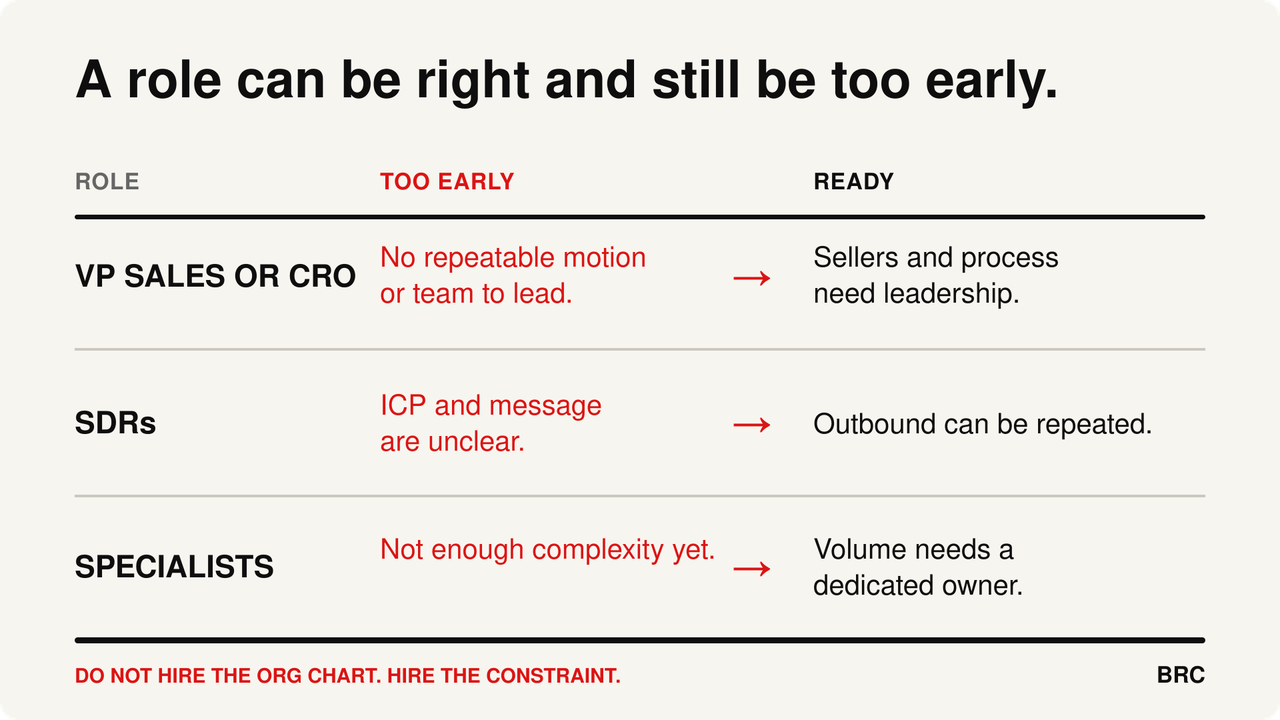
VP of Sales or CRO Too Early
If there is not yet a team or repeatable motion to manage, a senior sales leader may end up doing the same individual-contributor work the company actually needed from the beginning. Leadership becomes more useful once there is enough of an organization and process to lead. We have seen versions of this in searches at BRC. A company may initially believe it needs a senior sales leader because growth has slowed or the founder wants to step away from day-to-day selling. But once we get underneath the hiring request, the real need can look very different. If the sales motion still depends heavily on founder relationships, positioning continues to evolve, or there are not enough sellers to manage, another layer of leadership may not solve the problem. In those situations, the better hire may be a hands-on builder who is willing to prospect, sell, learn, and help create the process the eventual leader will inherit.
SDR Too Early
A team of SDRs cannot fix unclear positioning or poor targeting. If the company has not established who it wants to reach, why those buyers care, and what message consistently generates interest, adding more outbound activity can create more noise rather than qualified pipeline. Before scaling SDR headcount, make sure there is a motion worth scaling.
Specialists Too Early
Partnerships, enablement, segment leadership, and narrow operations roles can be valuable, but they need enough volume or complexity to justify having someone focused on them. The pattern is fairly simple: when the company is still building the motion, it usually needs people who can build and learn, not layers of people designed to manage something that does not exist yet
But Founders Can Also Wait Too Long
RevOps is one example
Once forecasting, reporting, routing, territories, compensation, and handoffs become difficult to manage, leaving those responsibilities with the founder or an overloaded generalist can start slowing the entire team down. Customer Success can also arrive too late. If retention, onboarding, implementation, or expansion still depend heavily on founders and sellers, it may be time to give those responsibilities to a dedicated owner. And when managers are stretched too thin, coaching becomes inconsistent, forecasts become less reliable, and decisions keep coming back to the founder, the company may already need another layer of leadership. The goal is not to avoid structure. It is to add structure when the complexity of the business actually requires it.
What Can Change the Hiring Sequence?
The funding stage is only one part of the picture. A company's average contract value, or ACV, can change the sequence. A higher-value, more complex sale may require more human selling and specialized support earlier. A shorter or more transactional sales cycle may allow the company to operate with fewer layers for longer.
Sales cycle length matters as well. A long, multi-stakeholder process affects pipeline requirements, ramp time, and when a new hire can reasonably be expected to produce results. The same applies to inbound versus outbound, founder involvement in sales, product-led versus sales-led growth, and market complexity. Regulation, technical requirements, procurement, multiple customer personas, and channel dependence can all shift the hiring roadmap. That is why one Seed company may need a different hire from another, even when both have raised the same amount of money.
The funding round tells you where the company is financially. The GTM motion tells you what the company is ready to hire. Before making the next hire, founders should look at what is actually limiting growth today, what has become repeatable, and what the next person needs to accomplish. The answer may be an AE, an SDR, a RevOps hire, a sales leader, or something else entirely.
The best hiring roadmap follows the company's actual maturity not the org chart it expects to have six months from now.
Not sure what your next GTM hire should be?
BRC works with founders and growth stage teams to identify the talent their business neeeds now not simply the role their funding stage suggests they should hire. Book a conversation with BRC, and we'll help you detemire what comes next.